Firethorn
Pyracantha has toothed, darker leaves and berries in open clusters.
Use the botanical sourceHippophae rhamnoides
Also found as Sallowthorn
A thorny coastal and mountain shrub with silvery narrow leaves and dense clusters of tart orange berries.
Sources checked 27 September 2026 · Specialist field review pending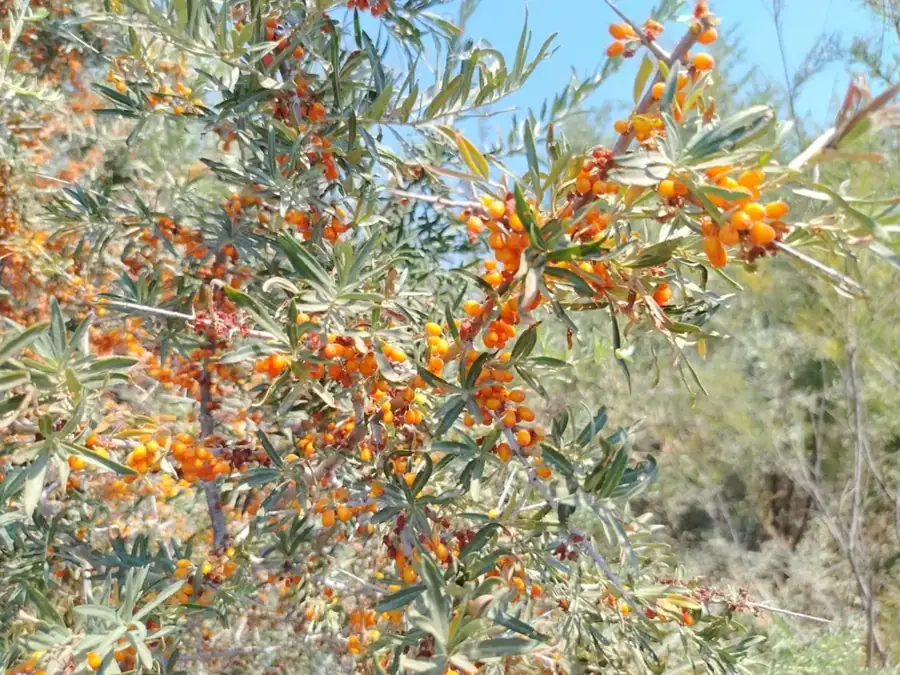
Very sour; the juice can be irritating raw in quantity.
Where it grows
| January | 246 |
|---|---|
| February | 217 |
| March | 363 |
| April | 1329 |
| May | 2006 |
| June | 2255 |
| July | 2703 |
| August | 3497 |
| September | 2118 |
| October | 1260 |
| November | 484 |
| December | 253 |
Research-grade iNaturalist records, snapshot Aug 27, 2026. The growing zone combines areas where different people have repeatedly verified it. Records show where people looked and found it, not current abundance or permission to gather.
01 / Learn to see
Thorny branches with narrow, silvery-green leaves.
Dense clusters of bright orange berries hugging the stems.
Separate male and female plants; only females fruit.
These are study prompts, not a complete identification key. Confirm the full plant with a regional flora and an experienced local identifier.
02 / Resolve the differences
Pyracantha has toothed, darker leaves and berries in open clusters.
Use the botanical sourceSelected comparisons only. Other lookalikes may occur locally.
03 / Meet the place
Native to coastal Europe and mountain valleys across Asia; widely planted.
Berries ripen in late summer to autumn.
Stage guidance is not a local forecast. Check your climate, elevation and a regional source; no month-shift formula is used here.
04 / Gather with care
Parts discussed: Fruit
Juice or cook berries. Freeze branches and knock off the berries to avoid crushing.
Cut small fruiting twigs rather than whole branches.
Preparation & storage essentials05 / Follow the evidence
Checked 27 September 2026. Original editorial synthesis; source institutions have not reviewed or endorsed this guide. Independent botanical field review is pending. Photos illustrate specimens; they do not certify the identity of a plant you find.
Suggest a correction