Lookalikes to rule out
Other Hydnum species
harmlessSmaller or dimpled relatives share the soft underside teeth and are generally treated similarly, though names vary by region.
Scaly Hedgehog
cautionSarcodon species have large dark scales and can be intensely bitter.
Hydnellum species
harmlessThese toothed fungi are woody or corky rather than brittle and tender.
What distinguishes a hedgehog mushroom?
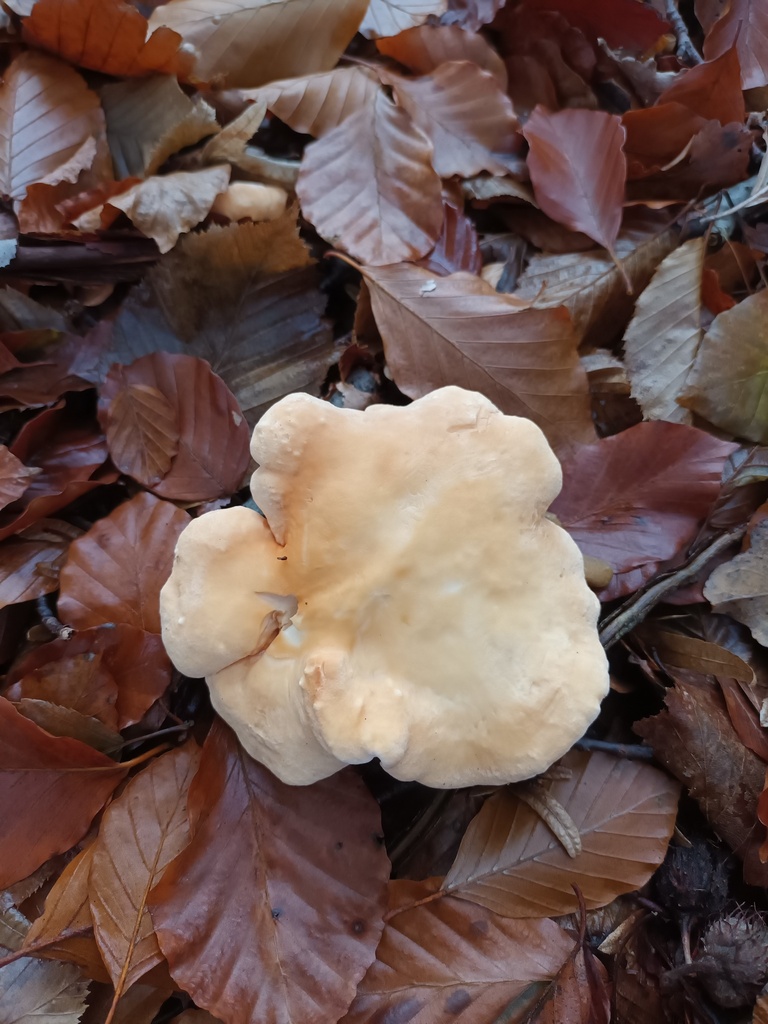
A pale, toothed underside is the first feature to document. The Missouri Department of Conservation describes Hydnum repandum with an uneven tan to orange cap, pale spines extending toward the stalk, and a white spore print. It grows from the ground in woodland. These are comparison features, not an edibility test.
Record a top view, a sharply focused underside, the stem and base, and the surrounding habitat. Include a scale and keep photographs from the same specimen together. Our identification documentation guide explains how to assemble a useful record for local expert review.
Hedgehog mushroom lookalikes and shared names
The word “hedgehog” is not a unique scientific identification. The Missouri guide also notes that Hericium erinaceus can carry that common name, although it forms a hanging, beardlike mass on wood. Compare its growth form with our lion’s mane profile.
Chanterelles have folds rather than separate teeth. Photograph the actual underside instead of judging by cap color. Other toothed fungi and regional Hydnum species still require a local reference; teeth alone do not settle the identification. Keep uncertain records at the broadest identification the evidence supports.
Habitat, season and observation records
The Missouri reference describes ground-growing mushrooms in mixed woodland and a July–November season in that state. That calendar should not be applied worldwide. Climate, local species and observation effort change what appears in the records.
Use the seasonal chart as a record of submissions, then open the map for the region you intend to visit. A sparse chart may reflect limited reporting. A photograph from last year does not establish current fruiting, and a public marker does not grant collecting permission. See reading mushroom seasons.
Ecology and food-use limits
Hydnum fungi form mycorrhizal partnerships with trees. Preserving the habitat is part of responsible field study. Where collecting is allowed, make only the collection needed for an agreed identification or documentation purpose.
An edible label describes an identified taxon. It does not identify a mushroom in your hand. Obtain qualified local confirmation before considering consumption, and use mushroom safety and poison-response guidance for suspected exposure.