Sausage tree
Kigelia has long sausage-shaped fruits that are toxic raw.
Use the botanical sourceAdansonia digitata
Also found as Monkey bread tree
An iconic African savanna tree with a massive trunk and velvety pods filled with tart, powdery pulp.
Sources checked 27 September 2026 · Specialist field review pending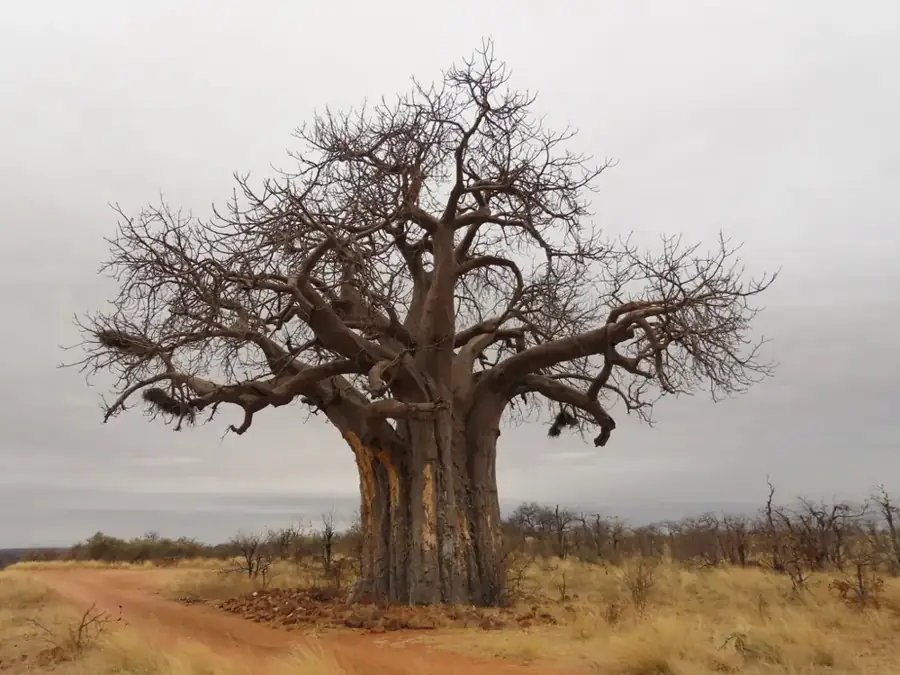
Respect community and customary ownership of trees.
Where it grows
| January | 181 |
|---|---|
| February | 124 |
| March | 115 |
| April | 71 |
| May | 111 |
| June | 97 |
| July | 78 |
| August | 73 |
| September | 79 |
| October | 69 |
| November | 167 |
| December | 90 |
| January | 228 |
|---|---|
| February | 211 |
| March | 229 |
| April | 442 |
| May | 244 |
| June | 384 |
| July | 363 |
| August | 446 |
| September | 394 |
| October | 261 |
| November | 520 |
| December | 250 |
Research-grade iNaturalist records, snapshot Aug 27, 2026. The growing zone combines areas where different people have repeatedly verified it. Records show where people looked and found it, not current abundance or permission to gather.
01 / Learn to see
Enormous swollen trunk with smooth gray bark.
Palmate leaves of five to seven leaflets, shed in the dry season.
Large white hanging flowers and velvety oval pods.
These are study prompts, not a complete identification key. Confirm the full plant with a regional flora and an experienced local identifier.
02 / Resolve the differences
Kigelia has long sausage-shaped fruits that are toxic raw.
Use the botanical sourceSelected comparisons only. Other lookalikes may occur locally.
03 / Meet the place
Dry savannas of sub-Saharan Africa; planted elsewhere.
Pods in the dry season; leaves in the rains.
Stage guidance is not a local forecast. Check your climate, elevation and a regional source; no month-shift formula is used here.
04 / Gather with care
Parts discussed: Fruit pulp · Leaf
Eat the dry pulp or mix into drinks. Young leaves are cooked as a vegetable.
Baobabs are long-lived and culturally important. Harvest fallen pods and leaves without damaging trees.
Preparation & storage essentials05 / Follow the evidence
Checked 27 September 2026. Original editorial synthesis; source institutions have not reviewed or endorsed this guide. Independent botanical field review is pending. Photos illustrate specimens; they do not certify the identity of a plant you find.
Suggest a correction