Common juniper
Extra care neededJuniper has sharp needles in threes and blue berry-like cones.
Taxus baccata
Also found as English yew · Common yew
A dark evergreen conifer with flat needles and red cup-shaped arils; seeds, needles and bark are deadly.
Sources checked 27 September 2026 · Specialist field review pending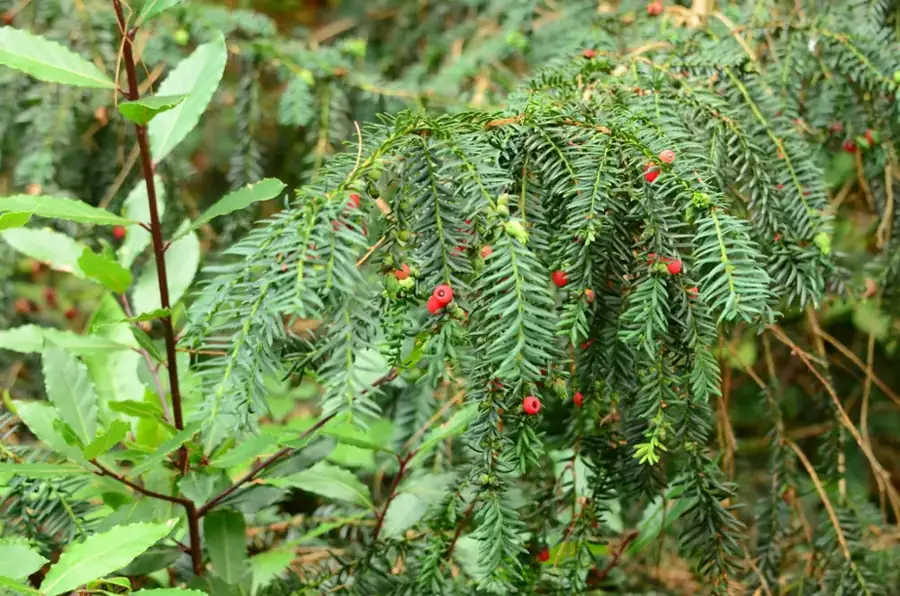
Contains taxine alkaloids that stop the heart. The red aril flesh is not toxic, but the seed inside is. Never eat any part.
Where it grows
| January | 874 |
|---|---|
| February | 1139 |
| March | 1659 |
| April | 2687 |
| May | 1675 |
| June | 1343 |
| July | 1347 |
| August | 1535 |
| September | 1477 |
| October | 1587 |
| November | 1099 |
| December | 871 |
Research-grade iNaturalist records, snapshot Aug 27, 2026. The growing zone combines areas where different people have repeatedly verified it. Records show where people looked and found it, not current abundance or permission to gather.
01 / Learn to see
Flat, dark green needles in two rows, pale green underneath.
Red, fleshy cup-shaped arils around a single seed.
Reddish, flaking bark.
These are study prompts, not a complete identification key. Confirm the full plant with a regional flora and an experienced local identifier.
02 / Resolve the differences
Juniper has sharp needles in threes and blue berry-like cones.
Firs have upright cones and resinous buds.
Use the botanical sourceSelected comparisons only. Other lookalikes may occur locally.
03 / Meet the place
Native to Europe, North Africa and southwest Asia; widely planted.
Hazard exists at every growth stage.
Stage guidance is not a local forecast. Check your climate, elevation and a regional source; no month-shift formula is used here.
04 / Gather with care
Do not eat, brew, taste or collect for the pantry.
Ancient yews are protected in churchyards; do not cut them.
Preparation & storage essentials05 / Follow the evidence
Checked 27 September 2026. Original editorial synthesis; source institutions have not reviewed or endorsed this guide. Independent botanical field review is pending. Photos illustrate specimens; they do not certify the identity of a plant you find.
Suggest a correction