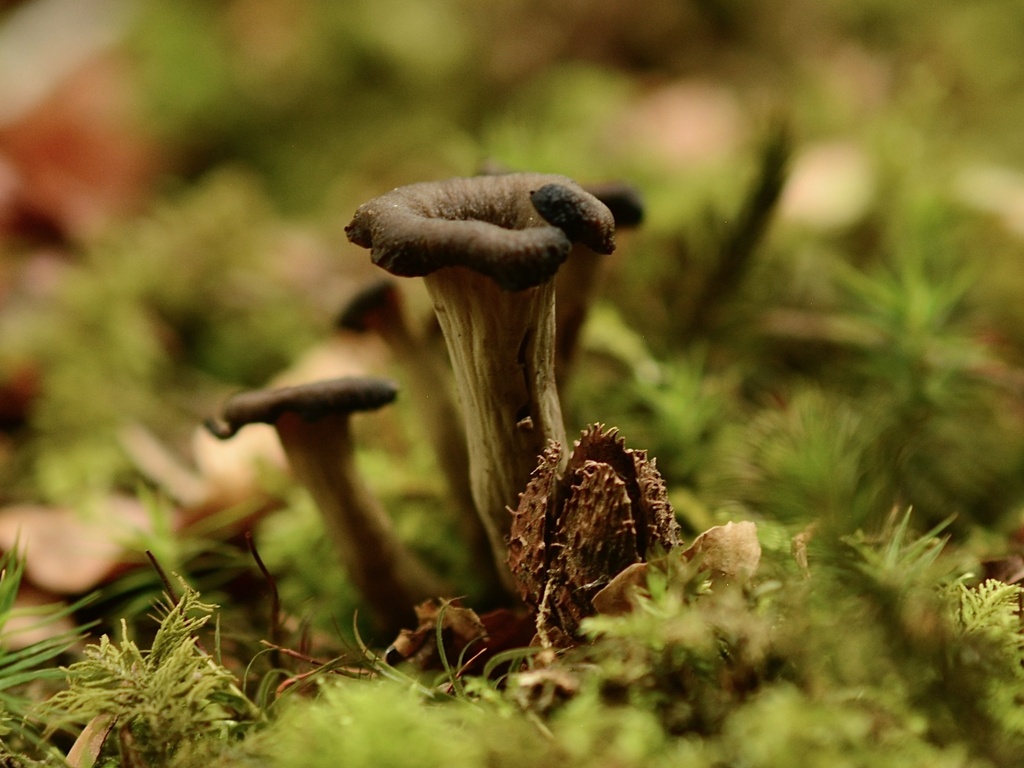
Lookalikes to rule out
Devil's Urn
cautionUrnula craterium is a thicker spring cup with a dark scaly exterior and tough flesh rather than a thin wavy trumpet.
Pig's Ear
cautionGomphus species are fleshier, often violet or tan, and have a veined, ridged outer surface.
Other Craterellus species
harmlessRegional black trumpets may require geography and microscopy to separate from this Eurasian name.
What should a black trumpet record show?
Document the complete funnel, its inner and outer surfaces, and its attachment to the ground. A US Forest Service field guide describes horn-of-plenty mushrooms as thin, hollow funnels with a smooth to lightly wrinkled outer spore-bearing surface. Their appearance changes with moisture: dark specimens may look browner or grayer as they dry.
A useful record needs more than a dark shape in leaf litter. Photograph the rim, the outside surface and the base in natural light, with a size reference. Note whether the specimen is hollow throughout and whether the outer surface has folds, gills or neither. Do not turn any single feature into a food-safety test.
Black trumpet lookalikes and regional names
The same Forest Service reference compares horn-of-plenty mushrooms with blue chanterelles: the latter form blue-gray to violet, fanlike structures rather than a hollow trumpet. Shape, interior and surface structure matter more than a shared dark color.
Common names can cover more than one scientific taxon. Older guides and present-day observation systems may organize related names differently. Record the reference you used, the observation region and any uncertainty rather than forcing every “black trumpet” into one species. The linked iNaturalist taxon provides the observation identity used by this page; it is not a substitute for a current regional identification key.
When and where do black trumpets appear?
The Forest Service guide describes forest-floor groups in conifer, hardwood and mixed woodland, with a western US season extending from late fall into winter or early spring depending on latitude. That regional account illustrates why a single summer–fall label is insufficient for a global map.
Start with a regional collection, examine dated records, and compare the local habitat with a regional field guide. Observation counts reflect reporting as well as mushroom activity. A heavily visited woodland can produce more records than a less visited habitat without having more mushrooms. Our seasonal interpretation guide explains these limitations.
Build a useful comparison record
- Keep photographs of the same specimen together, including the surrounding woodland.
- Record date, approximate locality, substrate and nearby trees without exposing a sensitive exact location.
- Note the proposed scientific name and the reference used. Preserve uncertainty when local expertise is needed.
- Compare multiple sources and ask a qualified person familiar with the region to examine the evidence.
Use recording finds to organize the observation and foraging permissions before planning a collection. An edible classification does not establish identity or safe preparation; never eat a mushroom based on this page or a map photograph.